← All Expeditions
Returning Soon
Northern British Columbia, Canada
Heli-Ski Expedition
Northern BC · New dates to be announced
This expedition isn't currently running. The March 2028 dates didn't reach the minimum number of participants, so it's on hold while we set a new departure. The programme itself is unchanged and ready to go again as soon as a new date is confirmed — including its ACRRM and CICM CPD accreditation, both of which remain valid for future editions of this trip regardless of the specific dates. Register your interest below and we'll contact you as soon as new dates are locked in.
Most CPD is forgettable. The venue is generic, the audience is passive, and the content disappears within a week. This programme is built on the opposite premise: that the best clinical learning happens when the group is small, the environment is demanding, and the people in the room are genuinely engaged — because they have just spent eight hours in terrain that required their full attention.
The clinical sessions run each evening — human factors, leadership, teamwork, case reviews and journal club, led by the programme team and, where relevant, by participants themselves. No lectures to a passive room. Small group discussion, real cases, current literature, and the kind of honest conversation about clinical practice that rarely happens in an institutional setting. The research on this is consistent: learning consolidates when people are physically activated, socially connected, and removed from the distractions of normal working life. The expedition is designed around that evidence.
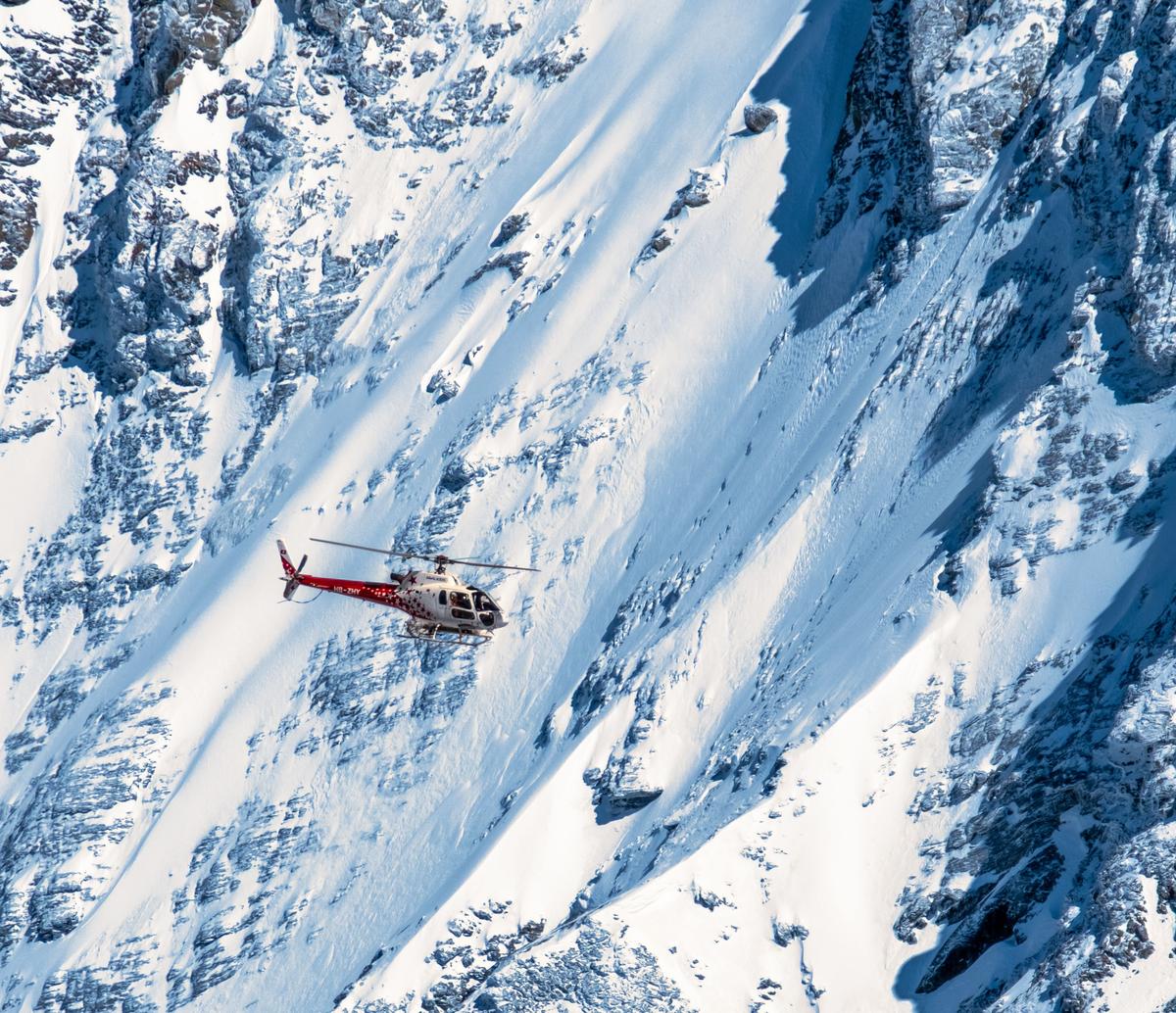
The terrain is exceptional, and that is not incidental. Deep in the mountains of northern British Columbia sits one of the largest heliskiing operations on earth. The heavy Pacific snowpack falls far enough into the range to give you skiing both above and below the treeline — open alpine terrain at the top, and the famous BC forests below that only grow where the snowpack runs this deep. Base is a beautiful backcountry lodge. Local runs deliver over 2,000 vertical metres, with snowcat backup when the weather requires it. Guides with deep knowledge of the terrain make the daily route decisions. Your job is to ski it, then come inside and think clearly about your clinical practice.
Intermediate off-piste, advanced on-piste. You need to be genuinely comfortable on variable, untracked terrain — this is not the trip to push your skiing to a new level, it is the trip to enjoy skiing that is already there. Some backcountry and avalanche experience is useful but not necessary — guides make all the route and hazard-assessment calls. If you are unsure, get in touch before registering.
Non-skiing partners are welcome to join, at $400 AUD per night — up to 5 places per trip. They receive the same lodge accommodation, meals and transfers as participants, but not the skiing itself and not the evening CPD sessions, which are participant-only. The onsite spa is available at an additional cost. This isn't suitable for children. Enquire the same way as the main trip — via this link or the "Ask a question" button opposite.
Not included: international flights, personal travel insurance, personal ski equipment (own skis welcome).
Sessions run each evening across the eight days — typically 2–3 hours, with longer structured blocks where the day allows. Evening sessions rotate through case discussions, short presentations, and journal club. Simulations run out in the terrain during the day. The group is small by design. After a day like this one, in terrain like this, the conversations that follow are not the conversations that happen in a conference room.
Case discussions are the centrepiece. Participants are encouraged — though never required — to bring their own cases. The ones that didn't go to plan. The call that felt right at the time and looks different in retrospect. As a group, we dissect the clinical and human factors elements: what happened, what shaped the decision, and what that means for practice going forward. Honest, specific, and genuinely useful.
Simulations are run out in the terrain during the day — structured clinical scenarios in the field, followed by facilitated debriefs. The focus is not on catching what went wrong but on understanding why, and on recognising the decision-making patterns that show up repeatedly in high-pressure clinical environments. The debrief is where the learning happens.
Presentations are short and deliberately opinionated. Not a tour through the evidence base, but a clinician telling you what they actually do and why — the gaps the guidelines don't fill, the approaches that took years to develop, the things worth saying plainly to a small group who will understand them.
Journal club gives the week a thread of current literature. Readings go out ahead of departure. The discussion is less about coverage and more about the habit of reading critically — and asking what actually changes how you practise.
Human factors run through all of it. Fatigue, cognitive load, situational awareness, team dynamics, the ways stress degrades clinical judgement before it degrades anything else. Not as a separate module — as a lens on every case, every simulation, every debrief. Eight hours a day in demanding physical terrain, followed by two hours of clinical discussion, creates a quality of engagement that is genuinely difficult to replicate anywhere else.
This expedition is formally ACRRM CPD accredited (2026–2028) and CICM CPD accredited. Content is also designed to meet ACEM and equivalent international CPD requirements — international participants are encouraged to verify acceptance with their own college or certifying body. A detailed programme and pre-reading will be circulated to registered participants ahead of departure.
Participants receive a CPD certificate and activity log at programme close. You are responsible for submitting this to your college or certifying body. All documentation required to do so will be provided.
Indicative schedule for when the expedition next runs. Exact dates and day-by-day timing will be confirmed with registered participants ahead of departure.
These conditions apply to all OffChartCPD expedition bookings. They exist to be transparent — about where your money goes, what happens if plans change, and what you need to have in place before you travel. Please read them before registering.
A deposit is required to secure your place. Deposits are paid to the trip operator — the specialist outfitter running the heliskiing programme — and are used immediately to hold your lodge, guiding, and helicopter time on your behalf.
These are small operators running tight logistics. When we take your deposit, real commitments are made on your behalf. Please only book if you intend to travel.
Refund entitlement is governed by the operator's own booking conditions, which vary by operator and by how far in advance of departure a cancellation occurs.
In most cases, deposits are non-refundable. Partial refunds of subsequent payments may be available for cancellations made sufficiently in advance. Specific terms will be provided at the time of booking. OffChartCPD cannot override operator refund policies.
This is why we require travel insurance.
If you are unable to attend, your booking can be transferred to another eligible participant. All transfers must be arranged through OffChartCPD — please do not make direct arrangements with other guests or the operator.
We will liaise with the operator to confirm eligibility and complete the transfer. Transfers may be subject to an administration fee and are not guaranteed in all circumstances.
All expeditions operate under the booking conditions of the respective trip operator. These will be provided to you in full before any payment is required.
By confirming your booking, you agree to be bound by both the OffChartCPD conditions on this page and the operator's own terms. Where there is any conflict, the operator's terms take precedence on matters of refunds, cancellations and logistics.
Some expeditions are costed by the operator in a foreign currency. The price shown reflects the exchange rate at the time of publication.
In the event of a significant adverse currency movement between your deposit and the date OffChartCPD settles payment with the operator, OffChartCPD reserves the right to apply a reasonable surcharge to cover the shortfall. We will always notify you in writing before any surcharge is applied — minor fluctuations are absorbed by OffChartCPD as a matter of course.
All participants must hold comprehensive travel insurance before their place is confirmed. Heliskiing in remote mountain terrain carries inherent risk, and medical evacuation from some of these environments can be complex and expensive. Insurance is not a formality.
Your policy must include all three of the following:
We strongly recommend purchasing insurance at the time you pay your deposit — not closer to departure. Cancellation cover only protects you from the date the policy is active. The specific policy is your choice; we do not endorse or receive any benefit from any insurance provider.