← All Expeditions
Antarctic Peninsula
Now Booking
Antarctic Peninsula
Antarctic Peninsula
Expedition
Polar Ski Mountaineering · 7–19 December 2027
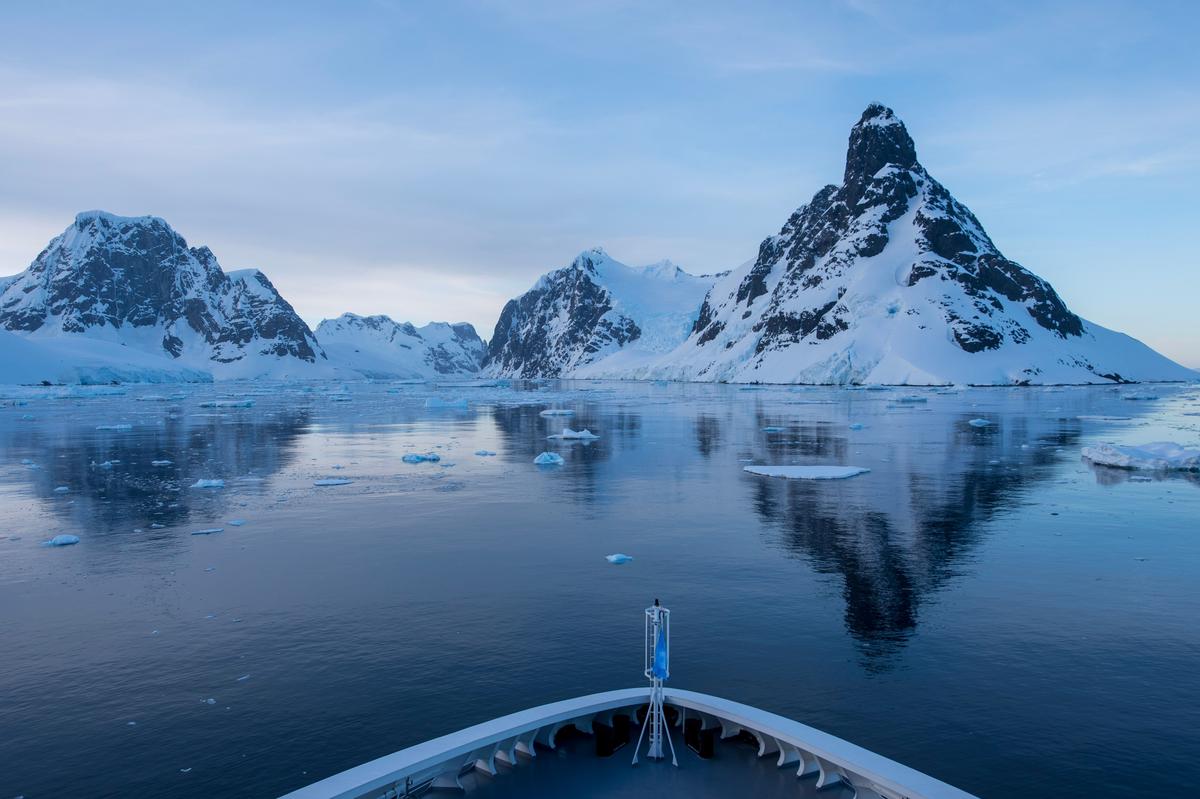
The Antarctic Peninsula is the most remote and arguably the most extraordinary environment on earth. You fly the Drake Passage — Punta Arenas to King George Island — rather than sailing it, then board a specialist polar vessel that threads through pack ice and between glaciated peaks while you ski on the peninsula itself — terrain that very few skiers, and vanishingly few clinicians, will ever stand on. The scale of the landscape is something that photographs don't adequately prepare you for.
This is a ship-based expedition: you live aboard, move between landing sites by Zodiac, and ski during daylight. Evenings are spent below decks — CPD sessions, case reviews, and the kind of sustained clinical conversation that happens when a small group of engaged clinicians is genuinely removed from the distractions of normal working life. The only thing competing for your attention is a glacier.
Dates are confirmed for 7–19 December 2027, with 13 places available for skiing participants — up to 15 in total if non-skiing partners join. Pricing is $29,800 AUD per person, including return flights between Punta Arenas and King George Island, all meals and soft drinks aboard, and guiding — get in touch to book your place.
This expedition requires solid off-piste skiing ability and a good baseline of physical fitness. You should be comfortable using ski touring equipment (skins, transitions, touring bindings) and skiing off piste in variable and unpredictable snow conditions, and ideally have some prior exposure to glacier travel (roped movement, crevasse awareness). Ski mountaineering experience beyond this is beneficial but not essential — guides set objectives based on conditions and group ability. If you are unsure whether your experience is sufficient, get in touch before registering.
Non-skiing participants are equally welcome. A dedicated polar guide runs shore excursions, wildlife viewing and other more traditional Antarctic Peninsula activities on days you'd rather not ski — there's no difference in price either way.
Travel to and from Punta Arenas is self-arranged and self-funded. Plan to arrive by 6 December — the day before the charter flight to King George Island — and avoid booking onward flights before 20 December, since Drake Passage flight operations are weather-dependent and delays are common. Baggage on the charter flight is limited to 22kg checked and 5kg hand luggage — pack ski equipment accordingly. Storage aboard is limited: bring a soft holdall-style bag only — large hard-shell or roller ski bags won't stow properly and can't be accommodated.
Accommodation in Punta Arenas for the nights before and after (6 and 19/20 December) is arranged and paid for separately by each participant. Hotel Diego de Almagro (around €160/night) and Hotel Cabo de Hornos (around €300/night) are recommended; cheaper options in the €100–130/night range are also available. These are advertised in euros — the expedition price itself will be quoted in AUD.
Not included: travel to and from Punta Arenas, accommodation in Punta Arenas before and after the expedition, personal ski mountaineering and avalanche equipment, personal travel insurance, guide gratuities, alcoholic drinks, and onboard Wi-Fi (available at $200 AUD per person for the duration of the expedition).
Sessions run each evening across the expedition — typically 2–3 hours, with longer structured blocks where the day allows. Evening sessions rotate through case discussions, short presentations, and journal club. Simulations run out in the terrain during the day. The group is small by design. The conversations that follow a full day in terrain like this are not the conversations that happen in a conference room.
Case discussions are the centrepiece. Participants are encouraged — though never required — to bring their own cases. The ones that didn't go to plan. The call that felt right at the time and looks different in retrospect. As a group, we dissect the clinical and human factors elements: what happened, what shaped the decision, and what that means for practice going forward. Honest, specific, and genuinely useful.
Simulations are run out in the terrain during the day — structured clinical scenarios in the field, followed by facilitated debriefs. The focus is not on catching what went wrong but on understanding why, and on the decision-making patterns that surface repeatedly in high-pressure clinical environments. The debrief is where the learning consolidates.
Presentations are short and deliberately opinionated. Not a tour through the evidence base, but a clinician telling you what they actually do and why — the gaps the guidelines don't fill, the approaches that took years to develop, the things worth saying plainly to a small group who will understand them.
Journal club gives the expedition a thread of current literature. Readings go out ahead of departure. The discussion is less about coverage and more about the habit of reading critically — and asking what actually changes how you practise.
Human factors run through all of it. Fatigue, cognitive load, situational awareness, team dynamics, the ways stress degrades clinical judgement before it degrades anything else. Not as a separate module — as a lens on every case, every simulation, every debrief. A full day in demanding physical terrain, followed by two hours of clinical discussion, creates a quality of engagement that is genuinely difficult to replicate anywhere else.
Designed to meet mandatory annual CPD requirements. International participants are encouraged to verify acceptance with their own college or certifying body. A detailed programme and pre-reading will be circulated to registered participants ahead of departure.
Participants receive a CPD certificate and activity log at programme close. You are responsible for submitting this to your college or certifying body. All documentation required to do so will be provided.
7–19 December 2027. Detailed day-by-day schedule will be confirmed with registered participants ahead of departure; the outline below reflects the programme structure and is subject to Antarctic weather and ice conditions.
You'll be aboard the Amazone, a two-masted, ice-class sailing schooner designed by the renowned Dutch naval architecture house Olivier van Meer Design. Built in 1963 as a North Sea fishing vessel, she was converted to a polar expedition schooner in 1993 and has been sailing Arctic and Antarctic waters ever since.
She's 42 metres long and 7.6 metres wide, with a draught of around 3 metres — solid enough for pack ice, agile enough for the narrow channels and anchorages of the Peninsula. Cabins are warm twin-share, each with heating and a sink; hot showers are available on board, shared rather than ensuite.
This expedition is run in partnership with Moretime Expeditions, a specialist polar sailing operator running small-group yacht and tall-ship expeditions to Antarctica and the high Arctic. Rather than the two-day sea crossing typical of larger cruise vessels, guests fly the Drake Passage — Punta Arenas to King George Island — saving time and avoiding the roughest open-ocean crossing, then board the vessel for the Peninsula itself.
The booking, logistics and day-to-day operation of the vessel and Peninsula programme sit with Moretime Expeditions. OffChartCPD manages the clinical and educational programme. The combination is the point.
These conditions apply to all OffChartCPD expedition bookings. They exist to be transparent — about where your money goes, what happens if plans change, and what you need to have in place before you travel. Please read them before registering.
A deposit is required to secure your place. Deposits are paid to the trip operator — the specialist outfitter running the programme — and are used immediately to hold your accommodation, guiding, and logistics on your behalf.
These are small, specialist operations. When we take your deposit, real commitments are made on your behalf. Please only book if you intend to travel.
Given the lead time and scale of this expedition, payment is staged: a 10% deposit (A$2,980) at registration, followed by three further instalments of 30% each (A$8,940 per instalment), due early February 2027, June 2027 and September 2027.
Instalments must be paid on schedule to retain your place — missed payments may result in forfeiture of the booking and prior instalments, in line with the operator's terms.
Refund entitlement is governed by the operator's own booking conditions, which vary by operator and by how far in advance of departure a cancellation occurs.
In most cases, deposits are non-refundable. Partial refunds of subsequent payments may be available for cancellations made sufficiently in advance. Specific terms will be provided at the time of booking. OffChartCPD cannot override operator refund policies.
This is why we require travel insurance.
If you are unable to attend, your booking can be transferred to another eligible participant. All transfers must be arranged through OffChartCPD — please do not make direct arrangements with other guests or the operator.
We will liaise with the operator to confirm eligibility and complete the transfer. Transfers may be subject to an administration fee and are not guaranteed in all circumstances.
All expeditions operate under the booking conditions of the respective trip operator. These will be provided to you in full before any payment is required.
By confirming your booking, you agree to be bound by both the OffChartCPD conditions on this page and the operator's own terms. Where there is any conflict, the operator's terms take precedence on matters of refunds, cancellations and logistics.
Some expeditions are costed by the operator in a foreign currency. The price shown reflects the exchange rate at the time of publication.
In the event of a significant adverse currency movement between your deposit and the date OffChartCPD settles payment with the operator, OffChartCPD reserves the right to apply a reasonable surcharge to cover the shortfall. We will always notify you in writing before any surcharge is applied — minor fluctuations are absorbed by OffChartCPD as a matter of course.
All participants must hold comprehensive travel insurance before their place is confirmed. These expeditions travel to remote environments where medical evacuation can be complex, expensive, and time-critical. Insurance is not a formality — it is a clinical and financial necessity.
Three specific items of cover are mandatory, not optional extras: your policy must name Antarctica as a covered destination, must separately cover backcountry/off-piste skiing and ski touring as an activity, and must include emergency medical evacuation with full repatriation to the mainland — not just to the nearest port or the ship's next port of call. A generic "worldwide" or "snow sports" policy will very often be missing one or more of these — see below for why. You will be required to provide evidence of all three — a certificate of currency or PDS excerpt showing Antarctica as a named destination, backcountry skiing/ski touring as a covered activity, and mainland medical evacuation/repatriation cover — before your place is confirmed. Bookings cannot proceed without it.
Your policy must include all of the following:
"Worldwide" cover is not sufficient on its own. Many policies define their "worldwide" zone in a way that specifically excludes Antarctica, cap medical evacuation at the nearest port or vessel rather than full repatriation to the mainland, and separately exclude off-piste skiing, ski touring and glacier travel (roped movement, crevasse terrain) unless you've added a specific snow sports or adventure activity pack. This trip requires all three — a policy that names Antarctica as a covered destination, medical evacuation cover that extends to full repatriation to the mainland, and a snow sports/adventure add-on that explicitly covers off-piste or backcountry ski touring and glacier travel. Missing any one of these leaves a genuine gap.
A few Australian insurers currently offer Antarctica as a selectable destination alongside a snow sports or adventure activity add-on — Cover-More (Antarctica – Cruising region, with a Snow Sports+ pack covering guided off-piste skiing) and Southern Cross Travel Insurance (snow cover add-on available on their International Comprehensive policy) are worth starting your search with. Treat this as a starting point, not a recommendation — we cannot recommend or endorse any specific provider — insurers change their PDS wording regularly, cover for ski mountaineering and roped glacier travel specifically (rather than resort or heli-skiing) is not always included even within a "snow sports" pack, and eligibility conditions (age limits, guide requirements, altitude caps) vary by provider.
Worth knowing: World Nomads — probably the insurer most commonly used by backpackers and adventure travellers — explicitly excludes expeditions and mountaineering activities in Antarctica on all of its plans, including its highest adventure tier. Don't assume a well-known "adventure travel" brand has you covered here; confirm in writing.
Call the insurer directly before you buy — don't rely on an online quote or a website's activity checklist alone. Online quote tools are built around ticking generic boxes like "snow sports" or "worldwide," and won't reliably capture something as specific as roped glacier travel on the Antarctic Peninsula, or the extent of evacuation cover. Speak to someone, describe the actual itinerary — Antarctic Peninsula ski mountaineering, Zodiac landings, and glacier travel with a roped IFMGA guide — and specifically confirm that medical evacuation extends to full repatriation to the mainland rather than stopping at the nearest port or the vessel's next destination. Then get their confirmation in writing (an email from the insurer is fine) before you pay. This is general information, not financial advice; the specific policy is your choice, and OffChartCPD does not endorse or receive any benefit from any insurance provider.
We strongly recommend purchasing insurance at the time you pay your deposit — not closer to departure. Cancellation cover only protects you from the date the policy is active.